
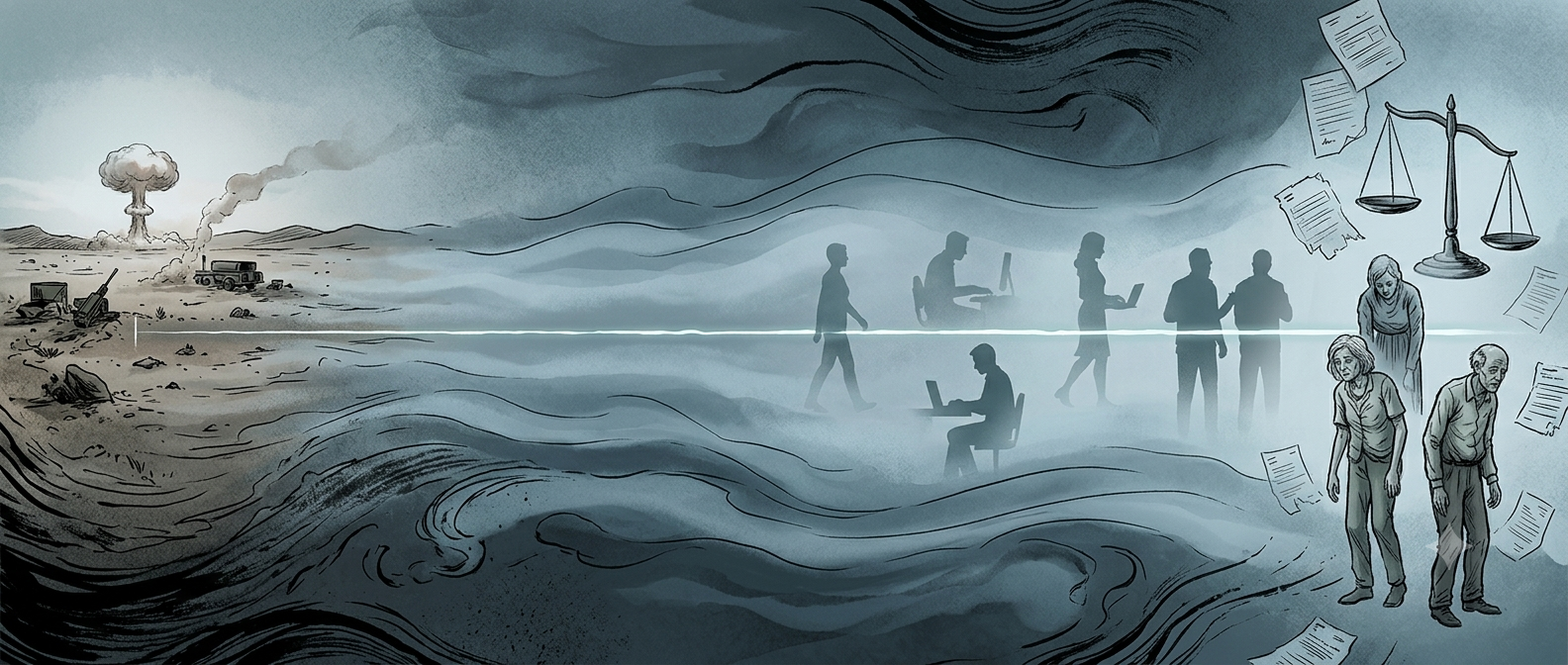
In the first article, we saw why nuclear risk fundamentally escapes the classical logic of liability law: invisible effects, delayed contamination, an individualised causal link that science cannot establish with certainty, and a state that was itself the source of the risk. Faced with this structural deadlock, the legislature had to invent a new model. From the simple presumption of 2010 to the irrebuttable presumption envisaged in 2026, it is an entire legal philosophy of compensation that is being rewritten and with it, perhaps, a new approach to risk law altogether.
From Simple Presumption to Irrebuttable Presumption: a Silent Revolution in Compensation Law
Faced with this deadlock, the legislature operated in 2010 a fundamental shift in logic. The law of 5 January 2010 on the recognition and compensation of victims of French nuclear testing no longer reasons in terms of classical liability. It establishes a legal compensation mechanism based on a presumption of causation.
The mechanism works as follows: if a person establishes that they suffer from a pathology recognised as radiation-induced under the scheme, and that they can justify a presence in the zones and during the periods linked to nuclear testing, then the link between their exposure and their illness is presumed. Applications are examined by the CIVEN, the Committee for the Compensation of Victims of Nuclear Testing. The central idea is that proof becomes achievable where an individualised scientific causal link is out of reach.
This presumption is however simple, and therefore rebuttable. The Conseil d’État has made this clear: it can only be set aside if the administration demonstrates that the pathology results exclusively from a cause unrelated to exposure to ionising radiation, in particular by establishing the absence of any effective exposure. It is precisely on this ground that thousands of cases have been rejected, that litigation has multiplied, that ageing victims have seen their claims mired in lengthy and technical procedures. The mechanism was more accessible than ordinary law, but it continued to generate a persistent tension between the logic of proof and the logic of reparation.
It is in this context that a major legislative development intervenes. A bill adopted by the National Assembly on 29 January 2026 aims to cross a new threshold. Its central contribution is the establishment of an irrebuttable presumption of exposure to ionising radiation from nuclear testing, once the legal criteria for qualification are met. The administration would no longer be able to rebut this presumption by challenging effective exposure. Compensation would become quasi-automatic for anyone satisfying the conditions of the scheme. The text has been referred to the Senate, its final adoption and entry into force remain to be seen.
The conceptual leap is considerable. With an irrebuttable presumption, the law no longer seeks to reconstruct a causal truth, even a partial one. It establishes a legal fiction: once you were present in the relevant zones, you are presumed to have been exposed, in an absolute and incontestable manner. The link between nuclear testing and individual harm ceases to be a question of fact and becomes a legal qualification. This shift reveals a profound mutation in the centre of gravity of the legal regime. It is no longer so much about establishing with certainty the origin of the damage as about ensuring effective reparation for exposed populations. The logic of solidarity and social insurance prevails over causal logic. The risk is socialised: it is the national community that, through public compensation, assumes the consequences of a state decision, without the victim having to scientifically demonstrate its effects on their own health.
A New Philosophy of Environmental and Energy Risk Law?
The case of nuclear testing is not an isolated one. It is part of a broader movement that contemporary risk law is currently experiencing.
To understand the scale of this evolution, it is necessary to recall the overall logic underpinning risk prevention in France. Two branches of law structure prevention: environmental law and planning law. The common assumption is that risks fall under environmental law alone, since natural and technological risk prevention plans are enshrined in the Environmental Code. Yet planning law also plays a role in prevention: the granting of planning permissions in exposed areas can give rise to liability. The most striking example remains Storm Xynthia and the municipality of La Faute-sur-Mer: 53 deaths, criminal proceedings against the former mayor for building permits granted in a flood-prone area, prosecution for endangering the lives of others. AZF illustrates the same problem from the other end: residential development had encroached on dangerous zones, and planning had aggravated the risk by failing to take it sufficiently into account.
Since 2015, Article L. 101-2 of the Planning Code explicitly enshrines this objective: among the purposes of planning law now figures the prevention of foreseeable natural, mining and technological risks. Planning documents — PLU (local urban plans), communal maps, SCOT (territorial coherence schemes) — must take these risks into account. The articulation is strong: approved risk prevention plans carry the status of public utility easements and must be annexed to the PLU, making them enforceable against planning permissions. There are therefore not two separate logics, environment on one side, planning on the other, but a growing interlocking of the two.
This logic of collective planning and prevention is found throughout risk law. On the natural risk side, natural risk prevention plans (PPRN) covered more than 12,500 municipalities out of approximately 35,000 as of 1 January 2025. On the technological risk side, a study published in 2023 draws an overall positive assessment of PPRT, reduction of risk at source, better involvement of local authorities, but points to persistent difficulties: populations struggle to understand land-use measures including expropriation, and approximately 30,000 people remain exposed to significant industrial risks. One recommendation emerges: creating a national industrial risk prevention fund, modelled on the Barnier Fund dedicated to natural risks.
This parallel between natural and technological risks, between prevention and compensation, between planning and collective reparation, outlines the contours of a legal philosophy in the process of asserting itself. As risks become massive, diffuse and scientifically complex, whether PFAS, asbestos, climate change or ionising radiation, the law seems to be evolving towards collective risk management rather than classical individual liability. Risk prevention plans operate within this logic upstream. Compensation schemes, natural disasters, asbestos victims, nuclear testing victims, constitute their downstream counterpart.
There lies, perhaps, the outline of a silent but profound transformation of environmental and energy risk law: less concerned with attributing responsibility than with ensuring effective protection of populations against the risks that industrial society generates, and that individuals, alone, can neither prevent nor prove.


