
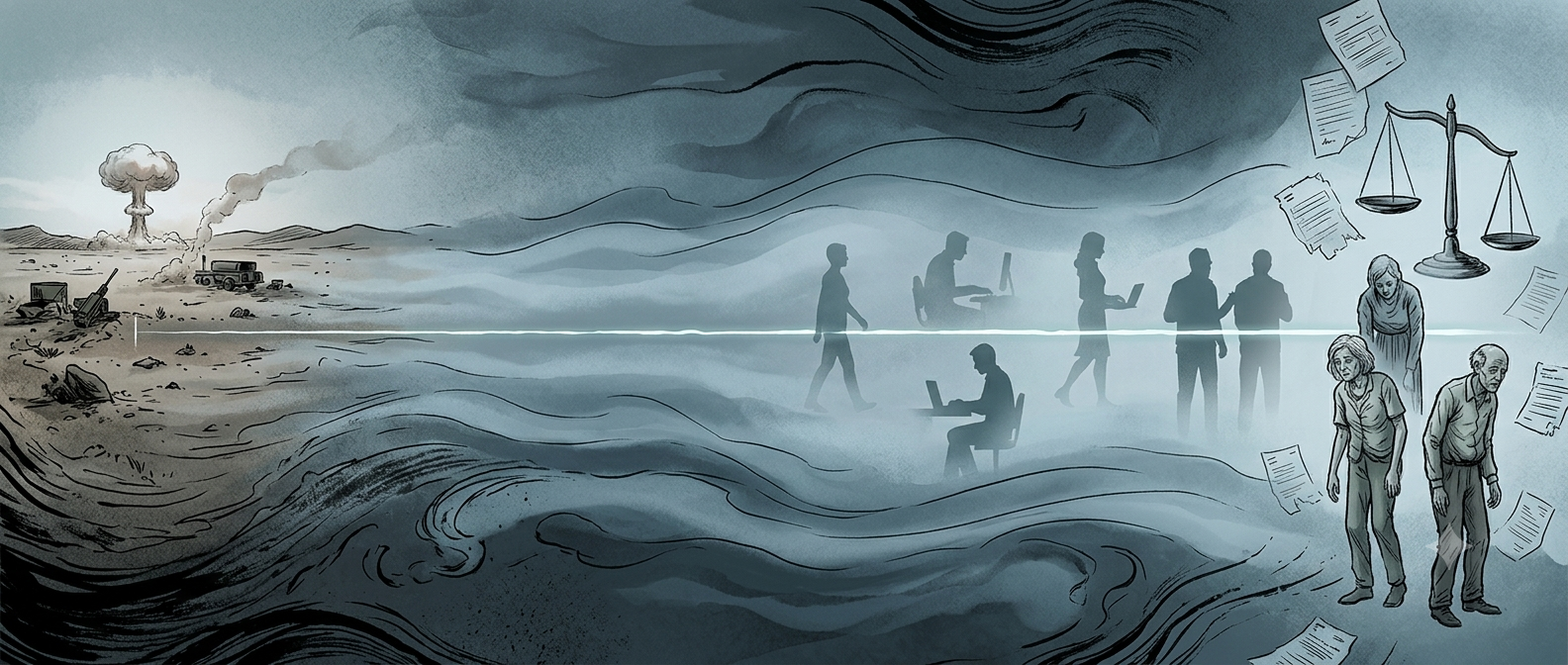
Feyzin, Seveso, Bhopal, AZF, every technological disaster has left a lasting mark on our law. But all of them shared one common feature: the damage was visible, dated, locatable. Victims could be identified, the danger zone could be defined, a responsible party could be named. Nuclear testing changed everything. Invisible radiation, silent contamination, cancers appearing thirty years after exposure, in distant territories, among populations who sometimes did not even know they had been exposed. Faced with this extraordinary risk, the classical law of liability showed its structural limits, and legislators had to invent something else. From the law of 5 January 2010 to the bill adopted by the National Assembly in January 2026, an entire legal philosophy of compensation is being rewritten.
A Law of Technological Risk Built Through Disasters
The law of technological risk was built around a series of industrial disasters, each of which left a lasting imprint on our legal system. Feyzin in 1966, the explosion of a refinery kills 18 people and durably shapes collective awareness of industrial risk. Seveso in Italy in 1976, a chemical plant causes mass evacuations and serious health consequences without any direct fatalities, inspiring an entire European directive. Bhopal in India in 1984, a gas leak at a pesticide factory kills more than 3,800 people and reveals the vulnerability of populations living near industrial sites. AZF in Toulouse on 21 September 2001,31 dead, more than 2,000 injured, and a national awakening to the coexistence of urban areas and hazardous sites. More recently, Lubrizol near Rouen on 26 September 2019, a fire with no casualties, but fumes whose health effects reignited the debate on public information and industrial transparency.
What these events have in common is that they are risks created by human activity. Technological risk covers a wide range of categories: industrial risk, nuclear risk, transport of hazardous materials, mining risk, dam failure. And behind each of these risks, the law has progressively built tools to anticipate and regulate them. The legal roots go back to the Imperial Decree of 1810, which for the first time regulated insalubrious factories and workshops, the idea was already to categorise dangerous activities, distance them from inhabited areas, and exercise state control over their location. The law of 1917 continued this logic. The law of 1976 on installations classified for environmental protection ( ICPE) established several regimes based on the level of hazard: declaration, registration since 2009, authorisation, and authorisation with easements for so-called upper-tier Seveso sites, subject to the strictest obligations. After the shock of AZF, the law of 30 July 2003 created the technological risk prevention plans (PPRT), modelled on natural risk prevention plans but with a stronger ambition: to reclaim land, to free up areas near dangerous industrial sites, including through expropriation, because residential development had crept too close to these sites over time.
Nuclear Risk: When Classical Law Reaches Its Limits
Nuclear risk fundamentally escapes this logic. It shares the same human origin as classical technological risks, but differs from them on several decisive points. Its timeframe is extremely long: the effects of ionising radiation can manifest decades after exposure, well beyond classical limitation periods. Its effects are diffuse and invisible: no locatable explosion, no visible smoke, no immediate sensation. The risk materialises in silence, in a delayed manner, in bodies that remain unaware for years.
Above all, contamination is impossible to attribute individually with the scientific certainty that liability law demands. How can one demonstrate, thirty years after the fact, that a thyroid cancer is linked to exposure during French nuclear testing in Polynesia or Algeria, and not to a genetic predisposition, smoking, or another environmental factor? This question is not rhetorical, it lies at the heart of thousands of rejected cases over decades.
This is where classical liability law reaches its limits. It rests on a fundamental trilogy: fault, damage, causal link. Yet this individualised causal link, scientifically established with certainty, is in this context virtually impossible to prove for any given individual. Science can establish probabilities at the population level, it cannot state with certainty that a specific cancer in a specific person resulted from a specific exposure. There is here a structural deadlock that the law could not ignore indefinitely. One final dimension must be added, one that the law cannot avoid: the French nuclear tests were conducted by the State itself, between 1960 and 1996, in colonial or post-colonial territories, Algeria first, then French Polynesia, which adds a considerable political and historical dimension to the legal challenge, and partly explains why the recognition of victims took so long to impose itself.

