
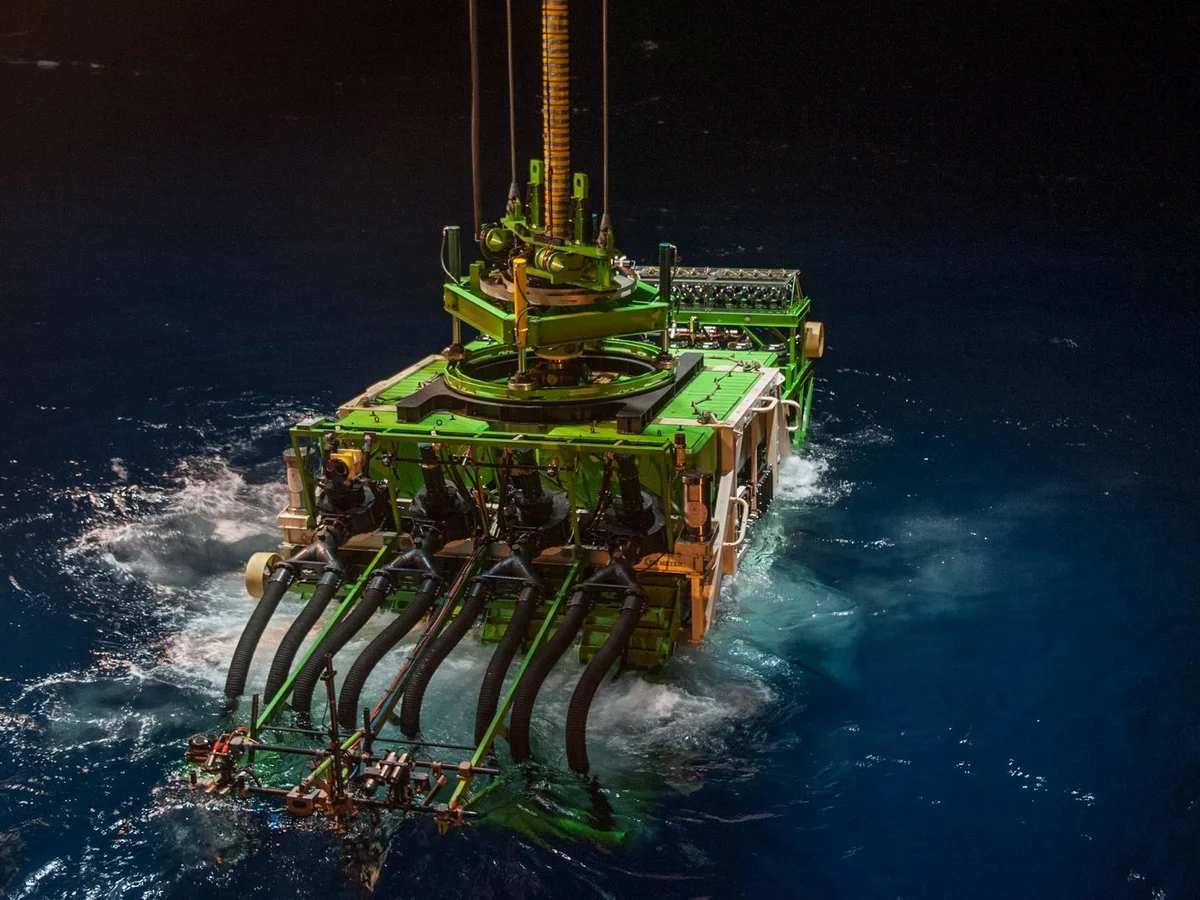
The global centers of economy is changing and the race for raw material is heating up and China is the undisputed leader. The US considers this a national security issue because whoever control these metals controls the future. The deep ocean is now a new battlefield.
What is deep sea mining ?
The process of removing mineral resources from the deep ocean floor, which is between 400 and 6.5 kilometers below sea level, is known as deep sea mining. According to the Secretary-General’s Scientific Advisory Board, deep sea mining targets three main sources of minerals: « polymetallic nodules, which contain manganese, nickel, copper, cobalt, and traces of rare minerals ; cobalt-rich crusts, which hold cobalt, manganese, nickel, lithium, and rare earths; and polymetallic sulfides, which contain copper, zinc, silver, and gold. » For example, in a area between Mexico and Hawaii there are at least 21 billion metric tons of these nodules : roughly 10 times the weight of all cars on Earth. Metals inside worth 9$ trillion, more than double the size of German economy.
All types of deep sea mining include some degree of seafloor erosion and discharges into nearby waters, while the technologies and effects differ based on the resource being extracted.
Why does it matters ?
The International Energy Agency has projected that the demand of critical for the energy transition will increase by four to six times by 2040 if we’re sticking to the Paris climate goal. That explain why some governments and companies are rushing to secure these minerals for their economies. The Metals company is a Canadian firm that plans to be first in line applied for mining permits from the International Seabed Authority in July 2025. The plan was to send bulldozer-like machines 3000 to 6000 meters below the surface to vacuum nodules along with everything living on them.
But deep-sea ming faces growing pushback because scientists say we barely understand the ecosystems at risk. For example, animals and microscopic animals that live in deep-sea communicate with light and chemistry and that chemistry is in now in danger because of deep-sea mining. The ocean store about 25% of our carbon emissions every year, provide nutrients that impact marine life far beyond the ocean floor and could hold life-saving medical treatments. The problem is that mining disturbs entire ecosystems we barely understand.
A fierce race between states
China is leading the charge with five exploration licences followed by Russia and South Korean. Regarding to the US, trump and his administration say that critical minerals and security of supply of energy alongside critical minerals are important. This race for minerals is governed by an international authority, the International Seabed Authority (ISA) which is : « an autonomous international organization established under the 1982 United Nations Convention on the Law of the Sea (UNCLOS) and the 1994 Agreement relating to the Implementation of Part XI of the United Nations Convention on the Law of the Sea (1994 Agreement). ». Its purpose is to bring together States parties and to organize and control all activities related to mineral resources in the area « for the benefit of humankind as a whole. ».
The ISA has 169 member states but the US isn’t one of them because in the 1970s they rejected the idea of deep-sea resources as a « common heritage of humanity. ». They accused the ISA of being world socialist government « worse than United Nations » according to the conservative activist Phyllis Schlafly. The United States argued that its Navy must retain the ability to navigate freely, wherever it dems necessary.
The ISA are the ones deciding who mines the ocean’s depths and how they can be exploited. They are supposed to balance resources extraction with environmental protection. But the ISA isn’t fully funded by the members states and relies on fees from deep-sea mining companies..
A structural conflict of interest
The ISA mainly funds itself through fees charged to contractors, including application and annual exploration contract fees. In doing so, these very same companies that the ISA is supposed to oversee and sanction if necessary. The more contracts and mining activity there are, the more revenue the Authority collects.
This is legally questionable as it sets up a financial incentive to expand the industry over applying caution, despite the ISA having a mandate under Article 145 of UNCLOS to protect the marine environment under Article 145 of UNCLOS. A regulator financially reliant on the entities they oversee might be less likely to impose harsh penalties, such as contract suspensions or extension denials, due to concerns over losing that financial support.
However, this point should be nuanced because the ISA is not entirely funded by mining companies. iIs budget combines contributions from member states with contractor fees. The issue is therefore not total dependency, but a partial and growing one, as the number of contracts increases which is precisely the structural problem at stake.
A concrete illustration is the ongoing dispute between the Metals Company and the ISA (summer 2026). The Authority initiated an investigation into non-compliance with a contractor that also supports its finances, illustrating the Authority’s regulatory responsibilities and financial dependency.
No code : the legal vacuum at the heart of deep sea mining
Five weeks of sparing in July 2025 closed the International seabed Authorities’s 30th session without a final mining code, but with notable movement. The council completed a second reading of draft exploitation rules and set up intersession work to keep negotiating between sessions. Work continued on a common heritage fund, paving the way for the operationalization of an economic planning commission, and November 1 was declared as the International day for deep Seabed.The 2026 Council session in Kingston, which also failed to adopt a code and give any mining approval, altered this dynamic.
This vacuum is what allows for unilateral action because it becomes easier for an outside actor a state that never ratified UNCLOS, or a contractor frustrated by the delay to argue that bypassing the Authority is not contravening international law, but rather closing a gap that the law has itself neglected to address.

