
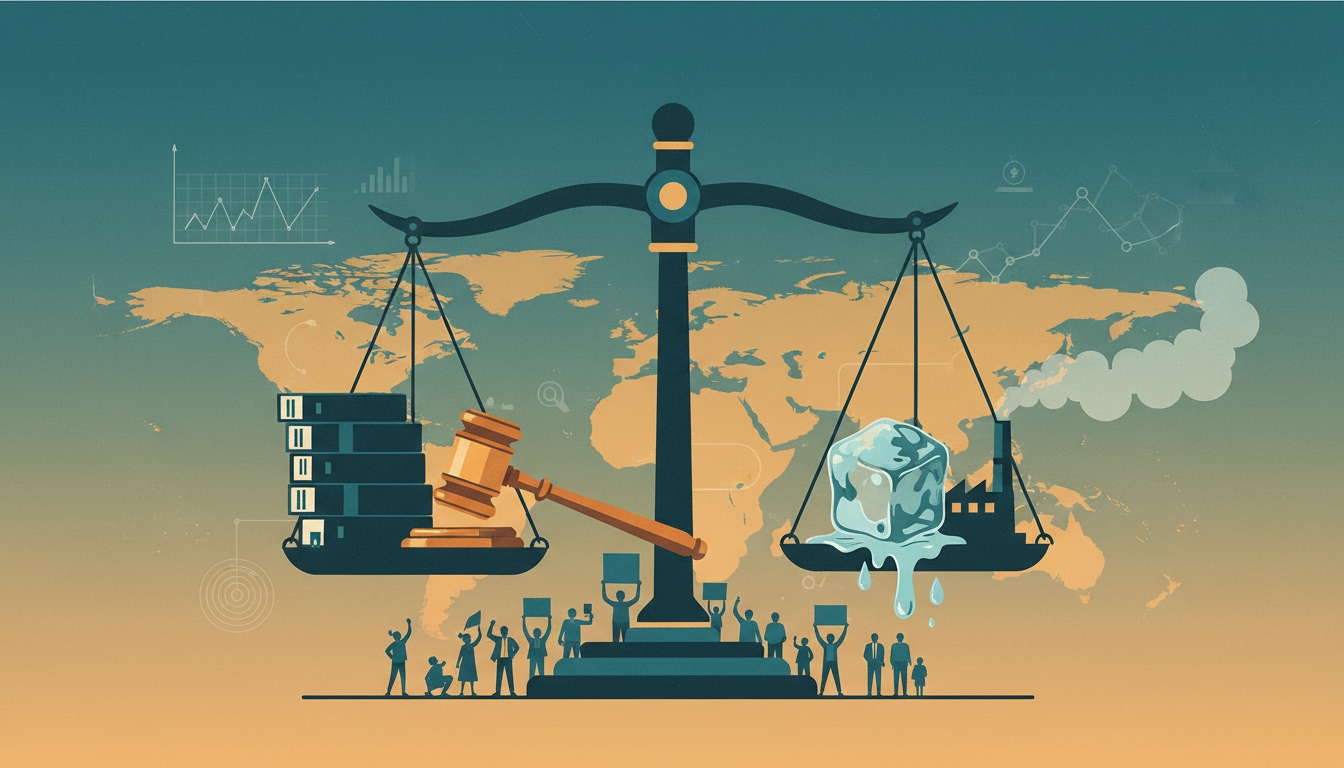
On 25 June 2026, the Paris judicial court is due to rule in the case brought against TotalEnergies for failing to meet its climate-related duty of vigilance. A few weeks earlier, the Dutch Supreme Court had heard the Shell case. It’s no coincidence that these two dates fall so close together: they show just how much climate litigation has been exploding worldwide over the past ten years. Here are five reasons behind this boom.
Numbers that keep climbing
First, the figures speak for themselves. According to the report published in October 2025 by UNEP and the Sabin Center for Climate Change Law at Columbia, 3,099 climate cases had been recorded worldwide as of 30 June 2025, up from 884 in 2017 and 2,180 in 2022. The number of new lawsuits keeps rising. These cases are now filed in 55 countries and before 24 international courts or bodies. The United States remains the most active jurisdiction, with nearly 2,000 proceedings, but countries in the Global South, long underrepresented, are catching up fast.
More and more legal arguments available
Second, the legal arguments plaintiffs can use have multiplied. Every courtroom win opens the door to new strategies. In the Netherlands, the Supreme Court ruled as early as 2019, in the Urgenda case, that overly weak climate targets violated the right to life. In Germany, the Federal Constitutional Court found in 2021, in the Neubauer case, that placing too much of the climate burden on younger generations violated their fundamental rights. In France, the Conseil d’État ruled, in the Affaire du Siècle, that the State was at fault for not doing enough. These decisions showed that human rights could serve as a legal basis for climate lawsuits. Since then, other areas of law have followed suit: consumer law (through greenwashing claims), civil liability, and duty-of-vigilance law.
International courts are getting involved too
Since 2024, major international courts have also taken up the issue. The European Court of Human Rights ruled, in KlimaSeniorinnen v. Switzerland, that an insufficient climate policy could violate the right to respect for private life. The International Tribunal for the Law of the Sea found that greenhouse gas emissions amount to a form of marine pollution. The Inter-American Court of Human Rights recognised, in 2025, a right to a healthy climate. And on 23 July 2025, the International Court of Justice unanimously issued a landmark advisory opinion: in its view, the Paris Agreement imposes binding obligations on States, the 1.5°C threshold is a genuine legal benchmark, and failing to meet it can trigger a State’s international responsibility. Four rulings in under two years, each one gives lawyers fresh arguments to cite before national courts, further accelerating the trend.
New targets: companies, banks, artificial intelligence
Climate litigation no longer targets governments alone: it now also reaches companies, their banks, and even artificial intelligence. Energy companies are on the front line. In the Netherlands, the Hague Court of Appeal overturned, in 2024, the order requiring Shell to cut its emissions by 45%, while still confirming that a climate-related duty of vigilance does exist; the Supreme Court is due to rule after hearing the parties on 22 May 2026. In Germany, the Hamm Court of Appeal ruled, on 28 May 2025, in Lliuya v. RWE, that a company could in principle be held liable for climate damage caused abroad. In France, TotalEnergies was found liable in October 2025 for misleading the public about its climate commitments, ahead of the 25 June ruling on its duty of vigilance. The movement is now reaching banks too: in April 2026, the NGO Milieudefensie sued a Dutch bank over its financing of fossil fuels. And the UNEP/Sabin Center report already points to the first lawsuits linked to the energy consumption of data centres used for artificial intelligence.
Even the backlash adds to the numbers
A fifth, more surprising reason: even opposition to the climate movement is fuelling the statistics. According to the Grantham Institute, of 226 cases recorded in 2024, 60 actually pushed back against climate policies, challenging the authority of public bodies to act or companies’ environmental commitments a trend particularly strong in the United States. These « anti-climate » lawsuits aren’t slowing the boom down, they’re part of it too.
These five trends reinforce one another: more legal arguments available, more international rulings to cite, more potential targets, and even more pushback. The result is that nothing suggests this boom is about to slow down. For energy lawyers, this isn’t just a theoretical question, it’s reshaping disclosure obligations, contract clauses, and corporate financing strategies across the sector. The ruling expected in the TotalEnergies case, like the one to come in the Shell case, won’t mark the end of this story, just one more step in a trend that looks set to continue.
Further sources:
- UNEP & Sabin Center for Climate Change Law (Columbia Law School), Global Climate Litigation Report 2025: Status Review, October 2025 unep.org/resources/report/global-climate-litigation-report-2025-status-review
- Grantham Research Institute on Climate Change and the Environment (LSE) & Sabin Center, Global Trends in Climate Change Litigation: 2025 Snapshot, June 2025 lse.ac.uk/granthaminstitute/publication/global-trends-in-climate-change-litigation-2025-snapshot
- Loyens & Loeff, New climate litigation against Shell, April 2026 https://www.loyensloeff.com/fr/insights/news–events/news/new-climate-litigation-against-shell/

